Career
| External video | |
|---|---|
 Mark Zuckerberg's career in 90 seconds, The Daily Telegraph Mark Zuckerberg's career in 90 seconds, The Daily Telegraph |
On February 4, 2004, Zuckerberg launched Facebook from his Harvard dormitory room. An earlier inspiration for Facebook may have come from Phillips Exeter Academy, the prep school from which Zuckerberg graduated in 2002. It published its own student directory, "The Photo Address Book", which students referred to as "The Facebook". Such photo directories were an important part of the student social experience at many private schools. With them, students were able to list attributes such as their class years, their friends, and their telephone numbers.
Once at college, Zuckerberg's Facebook started off as just a "Harvard thing" until Zuckerberg decided to spread it to other schools, enlisting the help of roommate Dustin Moskovitz. They began with Columbia University, New York University, Stanford, Dartmouth, Cornell, University of Pennsylvania, Brown, and Yale. Samyr Laine, a triple jumper representing Haiti at the 2012 Summer Olympics, shared a room with Zuckerberg during Facebook's founding. "Mark was clearly on to great things," said Laine, who was Facebook's fourteenth user.
Zuckerberg, Moskovitz and some friends moved to Palo Alto, California in Silicon Valley where they leased a small house that served as an office. Over the summer, Zuckerberg met Peter Thiel, who invested in the company. They got their first office in mid-2004. According to Zuckerberg, the group planned to return to Harvard, but eventually decided to remain in California. They had already turned down offers by major corporations to buy the company. In an interview in 2007, Zuckerberg explained his reasoning: "It's not because of the amount of money. For me and my colleagues, the most important thing is that we create an open information flow for people. Having media corporations owned by conglomerates is just not an attractive idea to me."
He restated these goals to Wired magazine in 2010: "The thing I really care about is the mission, making the world open." Earlier, in April 2009, Zuckerberg sought the advice of former Netscape CFO Peter Currie about financing strategies for Facebook. On July 21, 2010, Zuckerberg reported that the company reached the 500 million-user mark. When asked whether Facebook could earn more income from advertising as a result of its phenomenal growth, he explained:
I guess we could ... If you look at how much of our page is taken up with ads compared to the average search query. The average for us is a little less than 10 percent of the pages and the average for search is about 20 percent taken up with ads ... That's the simplest thing we could do. But we aren't like that. We make enough money. Right, I mean, we are keeping things running; we are growing at the rate we want to.
In 2010, Steven Levy, who wrote the 1984 book Hackers: Heroes of the Computer Revolution, wrote that Zuckerberg "clearly thinks of himself as a hacker". Zuckerberg said that "it's OK to break things" "to make them better". Facebook instituted "hackathons" held every six to eight weeks where participants would have one night to conceive of and complete a project. The company provided music, food, and beer at the hackathons, and many Facebook staff members, including Zuckerberg, regularly attended. "The idea is that you can build something really good in a night", Zuckerberg told Levy. "And that's part of the personality of Facebook now ... It's definitely very core to my personality."
Vanity Fair magazine named Zuckerberg number 1 on its 2010 list of the Top 100 "most influential people of the Information Age". Zuckerberg ranked number 23 on the Vanity Fair 100 list in 2009. In 2010, Zuckerberg was chosen as number 16 in New Statesman's annual survey of the world's 50 most influential figures.
In a 2011 interview with PBS shortly after the death of Steve Jobs, Zuckerberg said that Jobs had advised him on how to create a management team at Facebook that was "focused on building as high quality and good things as you are".
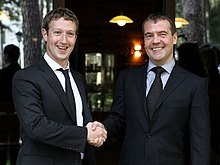
On October 1, 2012, Zuckerberg visited Russian Prime Minister Dmitry Medvedev in Moscow to stimulate social media innovation in Russia and to boost Facebook's position in the Russian market. Russia's communications minister tweeted that Prime Minister Dmitry Medvedev urged the social media giant's founder to abandon plans to lure away Russian programmers and instead consider opening a research center in Moscow. In 2012, Facebook had roughly 9 million users in Russia, while domestic clone VK had around 34 million. Rebecca Van Dyck, Facebook's head of consumer marketing, claimed that 85 million American Facebook users were exposed to the first day of the Home promotional campaign on April 6, 2013.
On August 19, 2013, The Washington Post reported that Zuckerberg's Facebook profile was hacked by an unemployed web developer.
At the 2013 TechCrunch Disrupt conference, held in September, Zuckerberg stated that he is working towards registering the 5 billion people who were not connected to the Internet as of the conference on Facebook. Zuckerberg then explained that this is intertwined with the aim of the Internet.org project, whereby Facebook, with the support of other technology companies, seeks to increase the number of people connected to the internet.
Zuckerberg was the keynote speaker at the 2014 Mobile World Congress (MWC), held in Barcelona, Spain, in March 2014, which was attended by 75,000 delegates. Various media sources highlighted the connection between Facebook's focus on mobile technology and Zuckerberg's speech, claiming that mobile represents the future of the company. Zuckerberg's speech expands upon the goal that he raised at the TechCrunch conference in September 2013, whereby he is working towards expanding Internet coverage into developing countries.
Alongside other American technology figures like Jeff Bezos and Tim Cook, Zuckerberg hosted visiting Chinese politician Lu Wei, known as the "Internet czar" for his influence in the enforcement of China's online policy, at Facebook's headquarters on December 8, 2014. The meeting occurred after Zuckerberg participated in a Q&A session at Tsinghua University in Beijing, China, on October 23, 2014, where he attempted to converse in Mandarin Chinese; although Facebook is banned in China, Zuckerberg is highly regarded among the people and was at the university to help fuel the nation's burgeoning entrepreneur sector.
Zuckerberg fielded questions during a live Q&A session at the company's headquarters in Menlo Park on December 11, 2014. The founder and CEO explained that he does not believe Facebook is a waste of time, because it facilitates social engagement, and participating in a public session was so that he could "learn how to better serve the community".
Zuckerberg receives a one-dollar salary as CEO of Facebook. In June 2016, Business Insider named Zuckerberg one of the "Top 10 Business Visionaries Creating Value for the World" along with Elon Musk and Sal Khan, due to the fact that he and his wife "pledged to give away 99% of their wealth — which is estimated at $55.0 billion."
In January 2019, Zuckerberg laid plans to integrate an end-to-end encrypted system for three major social media platforms, including Facebook, Instagram and WhatsApp. On August 14, 2020, Facebook integrated the chat systems for Instagram and Messenger on both iOS and Android devices. The update encouraged cross-communication between Instagram and Facebook users.
Wirehog
A month after Zuckerberg launched Facebook in February 2004, i2hub, another campus-only service, created by Wayne Chang, was launched. i2hub focused on peer-to-peer file sharing. At the time, both i2hub and Facebook were gaining the attention of the press and growing rapidly in users and publicity. In August 2004, Zuckerberg, Andrew McCollum, Adam D'Angelo, and Sean Parker launched a competing peer-to-peer file sharing service called Wirehog, a precursor to Facebook Platform applications.
Platform, Beacon, and Connect
On May 24, 2007, Zuckerberg announced Facebook Platform, a development platform for programmers to create social applications within Facebook. Within weeks, many applications had been built and some already had millions of users. It grew to more than 800,000 developers around the world building applications for Facebook Platform.
On November 6, 2007, Zuckerberg announced Beacon, a social advertising system that enabled people to share information with their Facebook friends based on their browsing activities on other sites. For example, eBay sellers could let friends know automatically what they have for sale via the Facebook news feed as they listed items for sale. The program came under scrutiny because of privacy concerns from groups and individual users. Zuckerberg and Facebook failed to respond to the concerns quickly, and on December 5, 2007, Zuckerberg wrote a blog post on Facebook, taking responsibility for the concerns about Beacon and offering an easier way for users to opt out of the service.
In 2007, Zuckerberg was added to MIT Technology Review's TR35 list as one of the top 35 innovators in the world under the age of 35. On July 23, 2008, Zuckerberg announced Facebook Connect, a version of Facebook Platform for users.
Internet.org
In a public Facebook post, Zuckerberg launched the Internet.org project in late August 2013. He explained that the primary aim of the initiative is to provide Internet access to the five billion people who are not connected as of the launch date. According to Zuckerberg, Internet.org would also create new jobs and open up new markets using a three-tier strategy. He stated in his post:
The world economy is going through a massive transition right now. The knowledge economy is the future. By bringing everyone online, we'll not only improve billions of lives, but we'll also improve our own as we benefit from the ideas and productivity they contribute to the world. Giving everyone the opportunity to connect is the foundation for enabling the knowledge economy. It is not the only thing we need to do, but it's a fundamental and necessary step.
Internet.org faced significant opposition in India, where activists said its limited internet ran counter to the idea of net neutrality; Zuckerberg said that a limited internet was better than no internet. Internet.org was shut down in India in February 2016. Zuckerberg later met with Narendra Modi, Satya Nadella and Sundar Pichai in the San Francisco Bay Area to discuss how to effectively establish affordable internet access in less developed countries. He also changed his Facebook profile picture to extend his support to Digital India to help rural communities stay connected to the internet.
Legal controversies
ConnectU lawsuits
Harvard students Cameron Winklevoss, Tyler Winklevoss, and Divya Narendra accused Zuckerberg of intentionally making them believe he would help them build a social network called HarvardConnection.com (later called ConnectU). They filed a lawsuit in 2004; it was dismissed on a technicality on March 28, 2007. It was refiled soon thereafter in federal court in Boston. Facebook countersued in regards to Social Butterfly, a project put out by The Winklevoss Chang Group, an alleged partnership between ConnectU and i2hub. On June 25, 2008, the case settled and Facebook agreed to transfer over 1.2 million common shares and pay $20 million in cash.
In November 2007, confidential court documents were posted on the website of 02138, a magazine that catered to Harvard alumni. They included Zuckerberg's Social Security number, his parents' home address, and his girlfriend's address. Facebook filed to have the documents removed; the judge ruled in favor of 02138.
Saverin lawsuit
A lawsuit filed by Eduardo Saverin against Facebook and Zuckerberg was settled out of court. Though terms of the settlement were sealed, the company affirmed Saverin's title as co-founder of Facebook. Saverin signed a non-disclosure contract after the settlement.
Pakistan criminal investigation
In June 2010, Pakistani Deputy Attorney General Muhammad Azhar Sidiqque launched a criminal investigation into Zuckerberg and Facebook co-founders Dustin Moskovitz and Chris Hughes after a "Draw Muhammad" contest was hosted on Facebook. The investigation named the anonymous German woman who created the contest. Sidiqque asked the country's police to contact Interpol to have Zuckerberg and the three others arrested for blasphemy. On May 19, 2010, Facebook's website was temporarily blocked in Pakistan until Facebook removed the contest from its website at the end of May. Sidiqque also asked its UN representative to raise the issue with the United Nations General Assembly.
Paul Ceglia
In June 2010, Paul Ceglia, the owner of a wood pellet fuel company in Allegany County, upstate New York, filed suit against Zuckerberg, claiming 84 percent ownership of Facebook and seeking monetary damages. According to Ceglia, he and Zuckerberg signed a contract on April 28, 2003, that an initial fee of $1,000 entitled Ceglia to 50% of the website's revenue, as well as an additional 1% interest in the business per day after January 1, 2004, until website completion. Zuckerberg was developing other projects at the time, among which was Facemash, the predecessor of Facebook, but did not register the domain name thefacebook.com until January 1, 2004. Facebook management dismissed the lawsuit as "completely frivolous". Facebook spokesman Barry Schnitt told a reporter that Ceglia's counsel had unsuccessfully sought an out-of-court settlement.
On October 26, 2012, federal authorities arrested Ceglia, charging him with mail and wire fraud and of "tampering with, destroying and fabricating evidence in a scheme to defraud the Facebook founder of billions of dollars." Ceglia is accused of fabricating emails to make it appear that he and Zuckerberg discussed details about an early version of Facebook, although after examining their emails, investigators found there was no mention of Facebook in them. Some law firms withdrew from the case before it was initiated and others after Ceglia's arrest.
Hawaiian land ownership
In January 2017, Zuckerberg filed eight "quiet title and partition" lawsuits against hundreds of native Hawaiians to purchase small tracts of land which they own. This land is contained within the 700 acres of land in the Hawaiian island of Kauai that Zuckerberg had purchased in 2014. When he learned that Hawaiian land ownership law differs from that of the other 49 states, he dropped the lawsuits.
Testimony before U.S. Congress
On April 10 and 11, 2018, Zuckerberg began testifying before the United States Senate Committee on Commerce, Science, and Transportation regarding the usage of personal data by Facebook in relation to the Facebook–Cambridge Analytica data breach. He has called the whole affair a breach of trust between Aleksandr Kogan, Cambridge Analytica, and Facebook. Zuckerberg has refused requests to appear to give evidence on the matter to a Parliamentary committee in the United Kingdom.
On 1 October 2020, the US Senate Commerce Committee unanimously voted to issue subpoenas to the CEOs of three top tech firms, including Zuckerberg, Google’s Sundar Pichai and Twitter’s Jack Dorsey. The subpoenas aimed to force the CEOs to testify about the legal immunity the law affords tech platforms under Section 230 of the Communications Act of 1934. US Republican argued that the law unduly protected social media companies against allegations of anti-conservative censorship.
Breakthrough Starshot
Zuckerberg co-founded and is a board member of the solar sail spacecraft development project Breakthrough Starshot.


Comments
Post a Comment